I have finished my experiments with the Kuleshov effect and have handed in my presentation. Here is the presentation I finished:
Showing posts with label BSA106. Show all posts
Tuesday, 16 October 2018
Saturday, 13 October 2018
1980 animation
1980 Computer Animation Milestones
Growth Model
Kawaguchi was a computer programmer and animator. He was a pioneer of computer software that grows images in an organic way. His program 'Growth Model' used algorithms to generate brightly coloured, psychedelic worlds digitally.
Dragon's Lair
In 1983, the arcade game name 'Dragon's Lair' caused a sensation within arcades with its full quality animated sequences, created by ex-Disney animator Don Bluth.
Commodare 64
Also in 1983, one of the first affordable home computers was released, the Commodore 64. One year earlier, the Sinclair Spectrum was released in Europe. This opened up the creation of computer graphics to everyone and inspired a generation of computer artist and programmers.
Autodesk Maya
Wavefront Technologies was formed in 1984 by Bill Kovacs, who along with Roy Hall, developed some of the software used on Tron. Kovacs then left and Hall was left developing some video manipulation and animation software. Then, in 1995, Silicon Graphics bought Wavefront Techologies and Canadian firm Alias Research to merge them to produce the advanced computer animation software 'Alias/Wavefront'. Softimage was released in 1988 and became the industry standard in animation, also the preferred choice for character animation. The first version of 3D Studio (3DS Max) was released by Autodesk in 1990. Autodesk later purchased Maya and Softimages and became the market leaders in high-end 3D animation products. Maya won the Oscar for technical achievements in 2003.
John Lasseter - Disney
Lasseter worked for Disney and created a test version for a CGI adaptation of the children's book 'Where The Wild Things Are', but due to the disappointing reaction from Tron, Disney felt that computer animation did not have much of a future and passed on the project. The film was then made by Spike Jonze in 2008, using extensive facial CGI.
John Lasseter - After Disney
Lasseter moved on to work at Lucasfilm and help create 'The Adventures of Andre and Wally B' in 1984. Soon after in 1986, this division of Lucasfilm was sold by George Lucas to Apple founder Steve Jobs (George Lucas needed the money from Steve Jobs, due to Howard the Duck being to unsuccessful). Lasseter then produced short films for the new company Pixar Animation Studios, including the short film 'Luxo Jr.' animation.
Steve Baron
Baron directed the music video animation 'Money for Nothing' in 1985, song created by Dire Straits. The animation was one of the first computer animated videos and is now a landmark in CGI. The animation was created by Ian Pearson and Gavin Blair. Baron also directed A-ha's 'Take On Me' music video in 1985. The video was animated by Micheal Patterson, who made the singer of the band come to life from a comic book using the rotoscoping technique.
Thursday, 11 October 2018
Plotting a plan
My game plan
Two weeks ago (I forgot to blog) I came up with a plan to get all my assignments finished on time, because at the rate I was going, it was too difficult and overwhelming to keep on track with all of my work at once. So, I decided to finish all my minor projects (BVA103 and BSA106) 'now' (before their due date) so that I could focus on my major projects. I noticed that my animation was taking up most of my time, so I then decided to focus on and complete my two other projects (BSA124 and BVA115). This was so that when the deadline came closer, I would not have to worry about the other projects so much and could focus on my animation (BSA127).
Pros: this game plan has been partially successful. I have finished and cleaned up my minor projects without too much stress. Also, I have finished building and setting up my stop-motion ready for shooting without much stress either. This makes me feel really happy and accomplished. :D
Cons: this plan has also been unsuccessful (due to stress). I have not completed my comic for I am currently only drawing up line-work for comic page 3, out of 8. I am (as expected) behind with my animation. Sadly, this has been causing me to get stressed (without my realisation) and sent me into my first panic attack during animation class on Tuesday (it's Friday now). It made me physically unable to work for a few a hours, even when I thought I was fine on Tuesday. Now, (since that occurrence) I have been struggling with constant panic attacks with everything I do. I know I am fine, and my body is just trying to cope with the stress I feel, but I am now getting even more behind in my work; it's a never-ending loop. :I
Now, I need a new game plan. I am meant to be finishing about 3 different animation shots per day. It has been 2 days now and I still haven't finished even 1. I have been telling myself that it's OK if I don't finish my animation on time for the deadline, that I will still finish it regardless. I also went to see a guidance counselor yesterday to get some help and was given really good advice. She confirmed that how I was reassuring myself was positive and helpful. Despite this, my body is still feeling really sick and uneasy due to stress. I learnt that if I act really happy and hyper to those around me, I seem to forget my stress-fulled body and feel healthy and happy once more. But this means that I am socializing instead of working.
I am not sure what to do, I was hoping to put my animation into an upcoming exhibition, meaning my animation is due on the 2nd of November at the latest. This means I have a good deal of time that I can use. I will not let the stress beat me yet. I will not plan to finish any specific number of animations, but to finish/start animating. Hopefully this will help me to get more work done. I wish to animate all day today, to catch up on my work. Tomorrow is comic day and then animation again the day after.
The stress will be long gone by the 9th of November. I will get though this :)
Monday, 1 October 2018
Uncanny valley
Uncanny valleys
Examples:
Uncanny valleys is a term describing when a being is similar to a human but something is missing, and instead makes it creepy. A common example of this is when robots look and act very similar to a normal human. An animation seen as an uncanny valley for many is 'The Polar Express'.
CB2, the child robot
CB2 is a child-like robot with a biomimetic body. CB2 is a platform for Cognitive-development Robotics built by JST ERATO Asada Project and Kokoro Co. Ltd. The robot responds and acts like a young child, even though CB2 is much larger than any normal sized toddler.
Saya, the reception robot
Mitsukoshi Nihombashi department store shows off its new humanoid robot receptionist who helps guide customers to the building's different floors. Toshiba is developing the technology behind the new robot's movements as well as syncing the movements of Aiko's mouth and voice at the same time. The system also uses technology developed by android pioneer Hiroshi Ishiguro at the Osaka University Intelligent Robotics Laboratory.
Reference
http://memolition.com/2016/09/02/creepy-examples-of-the-uncanny-valley/
Film 1980s
1980 films
In 1980, many films were produced, also film studios of the time created 'high concept' films. These films easily categorized characters and had familiar plots that could be described briefly. The films were also high on stylish and slick production qualities and aimed for mass appeal all over the world. This give a film its own soundtracks, videos, and promotion though other companies like fast food. The prototypes for 'high concept' films were 'Jaws', 'Star Wars', and 'Alien', all made in the 1970s. Although the prototypes were made in the 1970s, the people credited to creating the 'high concept' films are producer Don Simpson with partner Jerry Bruckheimer. These two created the films 'Flashdance', 'Beverly Hills Cop', and 'Top Gun'.
At this time, pre-teen/teenage comedy was in high production. The top four were 'Porky's', 'Screw Balls', 'Revenge of the Nerds', and 'Hot Dog'. A long with these examples, John Hughes made multiple teen orientated 'coming of age' films. These included 'Sixteen Candles', 'The Breakfast club', 'Weird Science', and 'Ferris Bueller's Day Off''.
1980 was also well known for introducing many sequels. Before 1980, there were very few sequels. Many of the sequels made were usually the same story retold in a different location. An example of this is 'Revenge of the Nerds' having three sequels made. Also, 'Porky's' having two sequels made. John Carpenter's highly successful film 'Halloween', made in 1978, caused the revival of horror films in the 1980s, with well over six sequels produced, and still being released. Some more examples of films with multiple sequels are 'First Blood' with over four sequels, 'Rocky' with six sequels, 'Terminator' with five sequels, 'Indiana Jones' with four sequels, 'Beverly Hills Cop' with four sequels, 'Die Hard' with five sequels, 'Lethal Weapon' with four sequels, 'Karate Kid' with three sequels, 'Ghostbusters' with one sequel, 'Police Academy' with seven sequels, and finally 'Gremlins' with one sequel.
Spoof films (comedy) were also very popular in the 1980s, with the creation of 'Airplane!' with one sequel, 'The Naked Gun' with two sequels, and 'This is Spinal Tap'. With animation at the time, 'Tron' and 'Who Framed Roger Rabbit' were made. 'Who Framed Roger Rabbit' was the most expensive film in the 1980s, costing 70 million to produce.
The science fiction films made in the 1980s were 'Blade Runner', 'Thing', 'Robocop', 'E.T.', and 'Back to the Future'. The war films made in 1980 were 'Gallipoli', 'Platoon', 'Full Metal Jacket', and 'Born on the Fourth of July'. The dance films made in the 1980s were 'Flashdance', 'Footloose', and 'Dirty Dancing'. The adventure films made in 1980 were 'The Goonies', 'The NeverEnding Story' which had two sequels produced, and 'Labyrinth'.
Marvel created the character 'Howard the Duck' in 1977. Disney threatened to sue Marvel over how similar Howard the Duck looked to Donald Duck. Marvel, in response, gave Howard the Duck pants. Howard the Duck was made into a film in 1986 and is regarded as one of the worst and least successful big-budget films ever made.
The well known 'Superman' was made in 1978 with three sequels made throughout the 1980s. The first 'Batman' was created in 1966, however, the more well known Burton's Batman was released in 1989. This was a huge success making over one billion dollars in profit, $400 million in film screenings and $700 million in merchandise.
Here are some more examples of films that made more money on the merchandise than the film itself:
- Transformers - $7 billion, not counting home video revenue being only $740 million
- Cars - $10 billion in global merchandising
- Frozen - $1.27 billion at box-office, $5 billion in 2014
- Minions - $267 million merchandising in 2014 alone, now $2.5 billion from just retail sales
https://www.ranker.com/list/movies-that-made-money-merchandising/jacob-shelton
Monday, 3 September 2018
Film reviews
Oscar Sharp
Sharp created BAFTA nominated short film 'The Karman Line' in 2015. Sharp then collaborated with technologist Ross Goodwin and created the world's first artificially intelligent screenwriter.
Benjamin - The Computer Screenwriter
Sharp created BAFTA nominated short film 'The Karman Line' in 2015. Sharp then collaborated with technologist Ross Goodwin and created the world's first artificially intelligent screenwriter.
Benjamin - The Computer Screenwriter
The artificial intelligence (AI) software was created to see if any form of AI software could write screenplays/create films. This software first created 'Sunspring' in 2016.
Later that year, the software named itself Benjamin. Benjamin then created a new screenplay, with the help of David Hasselhoff, called 'It's no game' in 2017. I think that the software was given help with the screenwriting, due to the film making sense.
Now, the creators of Benjamin wanted to have it be the director of the next screenplay it wrote, so they recorded a lot of footage of the actors speaking different dialogue, different classic film scenes from the 80s, and the basics of how to compose a music sheet for Benjamin to be able to create and choose the shots for the film. Benjamin then wrote and directed the film 'Zone Out' in 2018.
The creators of Benjamin are still upgrading and improving Benjamin's software, so we are likely to see a lot more films in future which are created and directed by Benjamin.
Sunspring (2016)
There was a lot of repeating dialogue like 'I don't know' and 'I do not understand'.
It's no game (2017)
This film made a lot more sense, with a story basis that I could follow and understand. The ending of the film didn't make much sense to me and seemed to consist of random quotes mashed together. I question if this film was made purely by the software Benjamin, but I can see that there are some links to the software's randomness.
Zone Out (2018)
There was no story-line that I could follow. As such, this was a lot more recognisable as a film made by Benjamin; it was like the first film 'Sunspring'. Such a strange film, but pretty cool how it was made by an artificial intelligence software.
Friday, 31 August 2018
World Animation 1970-1975
World Animation in 1970-1975
France
Serge Danot
Danot created the pilot for the TV series 'The Magic Roundabout'. There were over 500 hundred episodes made within 1963-1970. The style of animation with this series was stop-motion with a narrator helping the story be told. Also, in 1970, a feature film called 'Dougal and the Blue Cat' was released.
Norway
Ivo Caprino
Caprino perfected the technique of manipulating character figures in real time. This technique was an early version of animatronics. Though perfecting the technique, Caprino later switched to stop-motion and created the film 'Pinchcliffe Grand Prix' in 1975. The film itself took three and a half years to create. The film was very famous in Norway, creating box office records that still stand to this day. The film was shown daily in some theaters in Norway for 28 years after its first release.
Hungary
William Feigenbaum & Jozsef Gemes
Feigenbaum & Gemes created the children's film 'Hugo the Hippo' in 1975. This film became a huge favourite with adults. This film was the first feature length animated film to get an international release from Hungary.
France & Poland
Piotr Kamler
Kamler created the experimental short stop-motion film called 'The Step' in 1974. Although it's about five minutes long, it mostly repeats the first few seconds over and over to a sound track.
Japan
Hayao Miyazaki & Isao Takahata
Miyazaki & Takahata created the Japanese TV series called 'Heidi' in 1974, an adaption of the children's book called Heidi. Both Miyazaki & Takahata went forward to form the very well known 'Studio Ghibli' to produce their own feature films (including 'Spirited Away and Howl's Moving Castle).
Renzo & Sayoko Kinoshita
Renzo & Sayoko created 'Made in Japan' in 1972. Made in Japan was an animation about the Japanese culture putting the economy of Japan before anything else. Renzo & Sayoko also created what is considered to be one of the most harrowing and disturbing animated shorts called 'Pica-don' in 1978. 'Pica-don' is an animated depiction of bombing of Hiroshima, ending World War 2.
France & Czech Republic
Rene Laloux
Laloux created 'The Fantastic Planet' in 1973, based upon the novel 'Oms En Serie' by Stefan Wul. The film was about the world in society where humans had been taken to another planet to be pets. The film alludes to the social concerns of fascist repression and war as well as alternative culture and eastern mysticism.
USA
Richard Williams
Williams, the creator of 'Animators Survival Kit', created 'A Christmas Carol' in 1971. The animation was made for TV film but was later released in movie theaters and won the 1972 Academy Award for best animated short film. This win caused controversy and led to the Academy Awards changing its rules, deeming that TV movies could not be considered for the Oscars.
Ralph Bakshi
Bakshi created the first X-rated American cartoon called 'Fritz the Cat'. Bakshi believed that with all the changes in society and the new social power, it was time to take adult animation seriously. So, Bakshi took a comic strip character that was created by Robert Crumb. Fritz the Cat lives an alternative lifestyle among students in New York who experimented with free love, drugs and rock 'n' roll.
UK
Bob Godfrey
Godfrey created 'Karma Sutra Rides Again' in 1971 during the early 1970s craze for adult animation. Karma Sutra Rides Again is about a middle aged couple behind closed doors, including sex and its many possibilities. Godfrey believed that animation should concern the surreal and fantastic, rather than imitate realism. The film was given an X-rated certificate and screened alongside Stanley Kubrick's 'A Clockwork Orange' in the UK. Karma Sutra Rides Again was nominated for an Oscar for best animated short.
Renzo & Sayoko Kinoshita
Renzo & Sayoko created 'Made in Japan' in 1972. Made in Japan was an animation about the Japanese culture putting the economy of Japan before anything else. Renzo & Sayoko also created what is considered to be one of the most harrowing and disturbing animated shorts called 'Pica-don' in 1978. 'Pica-don' is an animated depiction of bombing of Hiroshima, ending World War 2.
France & Czech Republic
Rene Laloux
Laloux created 'The Fantastic Planet' in 1973, based upon the novel 'Oms En Serie' by Stefan Wul. The film was about the world in society where humans had been taken to another planet to be pets. The film alludes to the social concerns of fascist repression and war as well as alternative culture and eastern mysticism.
USA
Richard Williams
Williams, the creator of 'Animators Survival Kit', created 'A Christmas Carol' in 1971. The animation was made for TV film but was later released in movie theaters and won the 1972 Academy Award for best animated short film. This win caused controversy and led to the Academy Awards changing its rules, deeming that TV movies could not be considered for the Oscars.
Ralph Bakshi
Bakshi created the first X-rated American cartoon called 'Fritz the Cat'. Bakshi believed that with all the changes in society and the new social power, it was time to take adult animation seriously. So, Bakshi took a comic strip character that was created by Robert Crumb. Fritz the Cat lives an alternative lifestyle among students in New York who experimented with free love, drugs and rock 'n' roll.
UK
Bob Godfrey
Godfrey created 'Karma Sutra Rides Again' in 1971 during the early 1970s craze for adult animation. Karma Sutra Rides Again is about a middle aged couple behind closed doors, including sex and its many possibilities. Godfrey believed that animation should concern the surreal and fantastic, rather than imitate realism. The film was given an X-rated certificate and screened alongside Stanley Kubrick's 'A Clockwork Orange' in the UK. Karma Sutra Rides Again was nominated for an Oscar for best animated short.
New Hollywood
New Hollywood
The Beginning
During the Golden Age of Hollywood (1930-1960), most film directors worked for one of the major studios. The first act to change started when some French film critics noticed that some American Directors made films that were their own personal visions and were "auteurs" (authors of their own films). Examples being Alfred Hitchcock and Orsen Welles.
The first American New Wave started outside of Hollywood by independent film makers in New York. A film from this new wave was 'Little Fugitive', made in 1953 by Ray Ashley, Morris Engel & Ruth Orkin. The film 'Little Fugitive' was a huge influence on the French New Wave, with Francois Truffaut stating - "Our New Wave would never have come into being if it hadn't been for the young American Morris Engel, who showed us the way to independent production with this fine movie".
New York New Wave
Lionel Rogosin
Rogosin made 'On the Bowery' in 1956. This film was a Neorealist view of New York, that had a mixture of documentary and scripted footage.
Robert Frank
Frank made 'Pull My Daisy' in 1959.
John Cassavetes
Cassavetes made 'Shadows' in 1959. This film contained improvised dialogue and a narrative which included interracial romance, which was banned at the time of shooting.
Shirley Clarke
Clarke made 'The Connection' in 1961. This film was a mixture of cinema vérité and French New Wave. Her films depicted drug addicts, sex workers and different races mixing together.
New Hollywood
A new generation of young filmmakers emerged in the late 1960s and early 1970s. The studios lost the right to their own theaters (example, Paramount Antitrust case 1948) and the studios struggled to sell films to independent exhibitors and were losing their audience and money. They were also now competing with television.
In Britain, 1966, British films found success in America, examples being 'Alfie', 'Georgy Girl', and 'Blow Up'. The success of these films showed that the American audiences were open to films with more explicit content and different narrative structures to the Hays Code structure.
Jack Valenti was made the new head of the MPAA in 1966 and soon updated the outdated production code that had restricted film content. This allowed new freedom for filmmakers to make anti-authoritarian films which had appealed more to the younger audiences.
Robert Benton & David Newman
Benton & Newman (writers for the New York magazine) wrote a script for 'Bonnie and Clyde' in 1967 (based upon the American criminals who, during the Great Depression, robbed and killed people) and managed to get the script to French New Wave Director Francois Truffaut. Truffaut was supposed to direct the film but then pulled out to shoot 'Farenheit 451' in 1966. Truffaut then passed on the project to Jean-Luc Godard who also pulled out in favour of shooting 'Alphaville' in 1965.
Eventually, the actor Warren Beatty read the script for 'Bonnie and Clyde' and decided to produce it and hired Arthur Penn to direct. The film was also funded by Warner Brothers. Jack Warner disliked the rough cut and gave the film a limited release. The film also received a lot bad reviews. However, the film was well received in England. Beatty managed to get Warner Brothers to re-release the film and it became a success and was then nominated for Academy Awards. The film is notable for its depiction of sex and violence.
Mike Nichols
Nichols created 'The Graduate' in 1967. The soundtrack consists of songs by Simon and Garfunkel. The film introduced the world to Dustin Hoffman. The Graduate is about Benjamin Braddock, who has just finished college and is unsure of what to do with his future, when he becomes sexually involved with a friend of his parents, Mrs Robinson.
Sunday, 26 August 2018
Kuleshov effect
Apple's story
I have drawn up some different slides that all begin with an apple tree and a small child. I am testing to see if others will see if there is a 'story' shown though these different slides. If all separated, it makes no real story with the one image by itself. With the three slides, it creates new meanings without a narrator or words to show it. Here are the images I drew up:
From this, I created six different outcomes for a possible story that could be told.
Apple Building
Apple Destruction
Apple Family
Apple Break-up
Apple Relax
Apple Splat
Thursday, 23 August 2018
Film review
What We Do In The Shadows

This is a mockumentary about 'real' vampires living in a flat together in Wellington. The directors of this 2014 film are Taika Waititi and Jemaine Clement. It shows and exposes the habits of everyday vampires like drinking human blood, being hundreds of years old, and avoiding sunlight. Within this film, we are introduced to other creatures that also live in Wellington besides humans, like werewolves and zombies. Although the style of filming is like a documentary, there is drama that occurs with a climax, like when one of the main character's best friend is 'killed' by werewolves.
I would recommend this film for more mature audiences to watch. It is funny but not for children to watch as it contain adult themes such as death and torture. It's a funny film which shows a new view on how different human-like-creatures live and act normally. I did like how the different creatures could act like normal people with extra abilities. It was funny how they turned a normal kiwi man into a vampire.
Tuesday, 14 August 2018
Film Review
Cinéma Vértié and Direct Cinema
Forgotten Silver
Cinéma Vérité and Direct Cinema are very similar. Both techniques aim to elicit a 'real' response from the public. An example could be that the filmmakers ask for a random person from the public to answer a question or give a reaction to an event that occurs. They are like actors who do not know they are being filmed or that they are even actors in the first place.
Cinéma Vérité is when the filmmaker can participate with what is being filmed on camera, they are not stuck behind the camera being anonymous. Whereas, Direct Cinema is when the filmmaker does not participate in the events or results in front of the camera, being like 'a fly on the wall'.
A good example of Cinéma Vérité is 'Nanook of North' (1922). Robert J. Flaherty lived with the Inuit Artic natives for many years before taking a camera into the community. He focuses on a man called Nanook, and his family. The end result of the finished feature is considered the first "documentary" (1)
A good example of Direct Cinema is 'Grey Gardens' (1976). Albert and David Maysles explore the daily lives of two women, mother and daughter. Both mother and daughter have large personalities and live together, alone on an island estate (2)
Mockumentary
This film seems believable and was released under the guise of a documentary about Collin McKenzie, until revealed it was fake. Released on 11th of September 1997, this film made a lot of 'historic' claims that happened before the real pioneers created/finished their inventions. For example, flying before The Wright Brothers, having sound in film before 'The Jazz Singer' in 1927, and having coloured films before 'Cupid Angling' by Leon Douglass. Also, Collin McKenzie apparently 'made one of the largest man-made cities in New Zealand on the West Coast', this being a large scale biblical set for a film. To make this mockumentary even more convincing, the creators, Peter Jackson and Costa Botes, even got a famous film critic and historian, Leanard Malin, to attest to Collin McKenzie's significance.I would suggest that most people should watch this film. I, at first, thought it was real and factual. But once I figured out this wasn't the case, I thought the outrageous 'facts' were really funny to watch. It's a good film for (not just) New Zealanders to watch for some good humor with SOME actual history to it, like when it talks about the real pioneers and when they had their breakthroughs.
References
1) http://www.tasteofcinema.com/2015/10-essential-cinema-verite-films-every-documentary-fan-should-see/
2) https://www.rogerebert.com/reviews/grey-gardens-1976
Sunday, 12 August 2018
World animation 1965 - 1970
World Animation 1965 - 1970
Japan
Toei Doga
The Toei Doga company made the Japanese series Cyborg 009 as first a film (1966), followed by a squeal, then a TV series in 1968, a coloured TV series in 1979 and again in 2001. Cyborg 009 was originally a manga comic about a famous athlete how, after an injury, got transformed into a cyborg, with a mission to fight all evil.
Hiroshi Sasagawa
Sasagawa made used the manga comic, Mach Go Go Go into an animated series (1967). This series was sold in the West as Speed Racer. The Western version was less violent that the original series, with the characters being stunned instead of killed. After Astro Boy was created, the market opened up in the West for the under-animated effects, heavy style of Japanese anime.
USA
Disney
Disney created The Jungle Book (1967). This film was commented upon for it being the first time animated characters' movements were based upon the filmed performances of the voice actors (this is now standard practice). This was also the last animated film that Walt Disney was involved in (he died on December 15th 1966 of lung cancer).
Marv Newland
Newland created the short called Bambi Meets Godzilla (1969).
UK
George Dunning
Dunning created the series Yellow Submarine (1968). This series is about the Beatles agreeing to travel in a yellow submarine to rescue the inhabitants of a land where music and happiness are banned by the meanies. Each song was animated into a different unusual visual, making full use of the new technology at the time.
Oliver Postgate & Peter Firmin
Postgate and Firmin formed the company Smallfilms. Smallfilms produced many animated children's series including Ivor the Engine, Bagpuss and Noggin the Dog. Smallfilms worked out of a converted cow shed, their animation was basic, using handmade models like in The Clangers (1969).
USA and Japan
Jules Bass
Producer Jules Bass had MOM Productions in Japan make a stop-motion film called Mad Monster Party in 1967. This influenced the later work of Tim Burton. The cast in this film was famous monsters like Dracula and King Kong, but due to copyright issues, the character King Kong was referred to as "it".
Italy
Osvaldo Cavandoli
Cavandoli created an advertising film for the Italian TV show Carosello called The Line in 1969. The Line was then turned into comics and a TV series with 90 episodes being produced between 1972 and 1991.
Belgium
Belvision Studios
Belvision Studios adapted Asterix the Gaul, from the first volume of comics and graphic novels created by Rene Goscinny and Albert Uderzo, into 12 animated films (1967). The first film of Asterix was created without the consent or knowledge of Goscinny and Uderzo. By the time they found out, it was to late to stop the release. Goscinny and Uderzo forced the production of the sequel to be stopped, stating that the first film was cheaply made and did a disservice to the comics.
Canada
Eva Szasz
Eva directed the film Cosmic Zoom, which was based on the 1957 book Cosmic View by Kees Boeke, for the National Film Board of Canada in 1968. The film starts with live-action of a boy on a lake. It then zooms out into space, zooms back in to subatomic level, and back out to the boy on the lake live-action. Later, designers Ray and Charles Earnes released their film Powers of Ten in 1968, also based on Cosmic View.
Ryan Larkin
Larkin produced a sequence of award winning films in the 1960s in a free flowing, psychedelic, figurative style, one called Walking in 1969 which was nominated for the best animated short Oscar in 1970.
Croatia
Pavao Stalter & Branko Ranitovic
Stalter and Ranitovic directed an adaption of Edgar Allen Poe's classic horror tale The Masque of the Red Death in 1969.
Russia
Andrei Khrjanovsky
Khrjanovsky created There Lived Kozyavin (1966). The film was a commentary on the absurdity of faceless communist bureaucracy and despite the KGB interference in all Soviet film production, this film received approval for production. The other film Khrjanovsky made, The Glass Harmonica (1969) was not so lucky and became the first animated film to be officially banned in Russia.
USA & UK
Terry Gilliam
Gilliam is the creator of Storytime (1968) and Monty Pythons Flying Circus. Storytime was influenced by Death Breath (1964). Gilliam came up with his trademark anarchic animation style by using a mixture of cutout photos, Victorian imagery, surreal machines and strange illustrations.
Monday, 6 August 2018
Film review
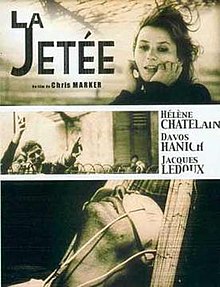
La Jetée
Directed by Chris Maker, in 1962 (France). La Jetée, as stated by director Maker, was largely influenced by 'A trip to the moon' made by George Melies in 1902. La Jetée has had a large influence on the films '12 Monkeys' and 'Terminator'
There were many themes explored within the film, including time travel into both the future and past, and a post-nuclear war experiment. The film was made of just pictures (except one scene when the female character looks up in her bed), juxtaposed into a story about a man and his time travel adventures. This film is a perfect example of the 'Kuleshov experiment'. I will use this film as an artist model.
I liked the film. It provoked and allowed me to think harder about the story line and wonder if there could have been a happier or different ending. Due to him being a temporary time traveler, maybe a different version of himself is alive out there. Or maybe it is as the film showed us, a man who was always haunted by his very clear memory of a traumatic event as a child. I would suggest this film to get a new and fresh point of view upon film making and how a story can be told.
Tuesday, 31 July 2018
First trial
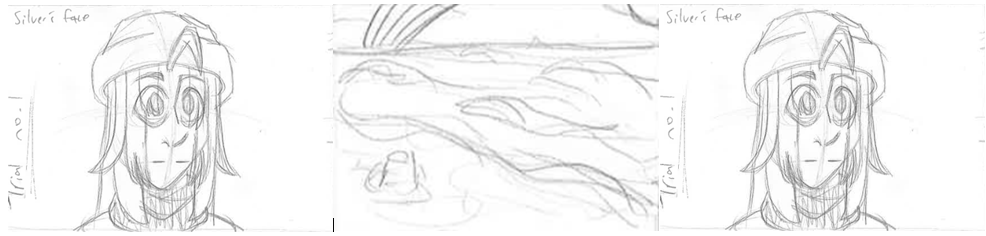
The first test with the Kuleshov effect with character's expressions.
With this test, there are multiple images in the center box in between the characters. You can pick/use any image you like to see a different result for the characters emotion or personality. Also, you do not have to use the last image with the character smiling, you can look back to the first image to give a new meaning.
This is the whole page. I will now cut or move images to see if they create different meanings.
Character. Silver Jewel
Background
The smile Silver gives after looking at the beautiful scene gives Silver personality. Silver seems to be happy to see the lovely scene. It makes him seem like a calm person, appreciating the scenery.
The constant blank stare Silver has towards the beautiful scene make us wonder if there is a reason he seems so blunt towards the scenery. Did something happen to Silver? Does he wish to be elsewhere?
Food
The smile Silver gives after looking at the food makes him not only seem a lot hungrier in the first image but also makes him seem pleased to see food that he will eat.
The constant blank stare Silver has towards the food does make him seem very desperate to eat the food. Silver could also be longing to eat the food but was told to wait and this is the face he gives.
Kitten
The smile Silver gives after looking at the kitten makes him seem like a kind animal lover. He likes kittens and as kittens are innocent, this makes him seem more innocent also.
The constant blank stare Silver has towards the kitten leads us to think about if is he waiting for the cat to do something cute so he can video it. He might also be thinking of his own cat longingly.
Lovers
The smile Silver gives after looking at the lovers make Silver seem like a helpless romantic, fantasying about his own possible romance he dreams to have. He seems pure looking at their love.
The constant blank stare Silver has towards the lovers makes us wonder if Silver has ever fallen in love or been heart broken. Maybe his stare is him remembering the joy he felt before the heart break.
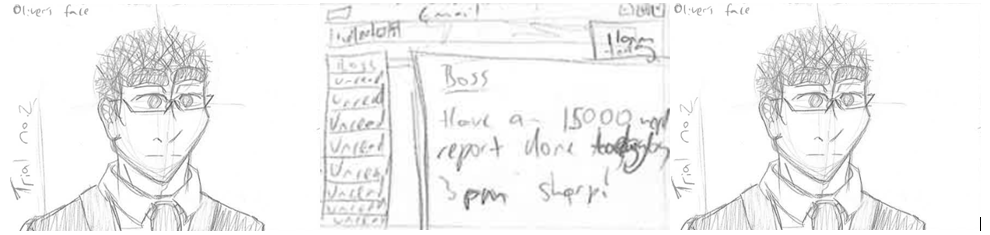
Character. Oliver Moore
Bookshelves
The smile Oliver gives after looking at the bookshelves makes Oliver a man of knowledge. He now seems a lot smarter and more like a bookworm. Oliver seems excited to learn more.
The constant blank stare Oliver has towards the bookshelves does make Oliver seem like a man who is about to get down to business. He also seems like a man who is about so have a long boring night.
Email
The smile Oliver gives after looking at his email gives Oliver a more kind or tolerant personality. With 15000 words due in 4 hours, it would be hard. Oliver also seem to really love his job or writing.
The constant blank stare Oliver has towards his email makes Oliver seem more human, and unimpressed. He stares blankly at the ridiculous request from his boss. It looks kinda funny to us.
Picture frame
The smile Oliver gives after looking at the picture frame has us seeing Oliver is a much softer light. It reminds us that he has a family he loves and works to support. Oliver seems a lot more loving due to his smile.
The constant blank stare Oliver has towards the picture frame has us thinking about his family. Why are they not around? Oliver seems to look sad at the picture frame, even though it's a neutral face.
Work-space
The smile Oliver gives after looking at his work-space shows us that he loves his job. He seems more eager and excited to work in his amazing job.
The constant blank stare Oliver has towards his work-space makes Oliver seem restless and tired of his job. Oliver seems like he wishes to be elsewhere or to have a change in his life.
Character. Gabranth
Child
The smile Gabranth gives after looking at the crying child makes Gabranth seem to be a very cruel and twisted man. He seems to be a very dark-natured man with evil intent, smiling at the child's tears.
The constant blank stare Gabranth has towards the crying child still makes him all that was just stated above, but, he also has a coldness to him with his icy glare. He is fed up with the child.
Grave
The smile Gabranth gives after looking at the grave gives Gabranth a morbid sort of personality. He seems to be smugly smiling at his possible opponent or victim, satisfied with their death.The constant blank stare Gabranth has towards the grave makes Gabranth seem to be very depressed because of their death, or lost. He seems very spaced out and uncertain because of the grave he sees.
Crown
The smile Gabranth gives after looking at the crown gives Gabranth a selfish or greedy personality. He wants the crown, the crown is power. He wants to be in charge or be rich because of the crown.
The constant blank stare Gabranth gives the crown makes us wonder why he is dismayed by it. He could long to be king instead of another. Maybe he's overwhelmed by the responsibility of the crown.
Knife
The smile Gabranth gives after looking at the knife in the picture makes Gabranth seem like a man fueled by revenge. He seems very sinister with his cold glare and smug smirk.
The constant blank stare Gabranth has towards the knife in the picture has made Gabranth seem to either look unsatisfied with the result of the knife, or to be plotting his next move to attack the victim.
I can place all these images into either Toonboom-Storyboard Pro, Toonboom-Harmony or AfterEffects to create a short film to present my work.
Subscribe to:
Posts (Atom)